
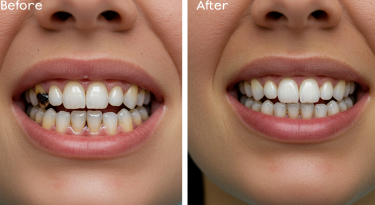
Here, we explain how cavities are treated in Dental Fillings in Mesa, AZ, when small lesions or deeper decay are found by evaluating enamel structure and overall tooth condition.
At Martin Dental, we help you understand options—so you can decide what care fits. Depending on findings, fillings address decay-related damage and support normal function.
Service Standards to Discuss
-
Examine the tooth and surrounding structures to assess cavity size, location, and signs of deeper decay.
-
Discuss whether a small lesion may be monitored or needs restorative treatment based on clinical findings.
-
Consider enamel thickness and remaining tooth structure when evaluating suitable filling options.
-
Review findings with Dr. Smith, DDS, to distinguish preventive care from treatment for established decay.
What to Know About Dental Fillings
A small cavity confined to enamel—the tooth’s hard outer layer—may need less repair than decay that has spread deeper, where the extent of damage can change the treatment plan. Dr. Smith (DDS) can assess the tooth and explain whether a dental filling is appropriate; appearance alone cannot confirm cavity size or depth.
Tooth-colored composite fillings bond to tooth structure, but the amount of healthy enamel and remaining tooth affects what can be repaired. If an existing filling is worn or damaged, replacement may be considered after an examination.
Keyword Pool
Dental fillings, also known as cavity fillings, repair teeth affected by decay after a dentist assesses its extent.
Tooth-colored composite fillings can restore a tooth’s appearance, while filling replacement may be considered if an existing restoration is damaged or no longer seals well.
Small lesions may need less restorative work than deeper decay; enamel thickness and the decay’s depth help guide care.
Dr. Chapin Smith, DDS, can evaluate the findings and discuss appropriate options.
Assessment and Service Options
Small cavities limited to enamel may be managed differently from decay that has reached the softer dentin beneath it. To decide whether a filling is appropriate, Dr. Chapin Smith, DDS, considers the tooth’s symptoms, examination findings, decay’s size and depth, and X-rays when indicated.
A filling can restore structure after decayed tissue is removed; deeper damage may require a different approach.
Enamel thickness and the amount of healthy tooth remaining also affect what can be preserved.
Questions Before Booking
Can a small cavity be treated before it reaches deeper decay?
Often, early decay limited to enamel may be managed differently from a cavity that has damaged more tooth structure.
If decay has formed a hole, A filling can restore the area; deeper decay may require further assessment to determine suitable care.
Why should I see Dr. Smith for a filling in Mesa?
Dr. Chapin Smith, DDS, leads Martin Dental’s Mesa location, which focuses on periodontics and patient relief.
A consultation can help clarify whether a filling is appropriate and what care is recommended.
Why Choose Martin Dental?
Martin Dental has served the East Valley for 15+ years with three offices in Queen Creek, Chandler, and Mesa.
Dr. Brett Martin, Dr. Chapin Smith, and Dr. Adam Kenney provide thorough care using in-house labs and digital scanners.
We accept most insurance plans.
Request Your Consultation.
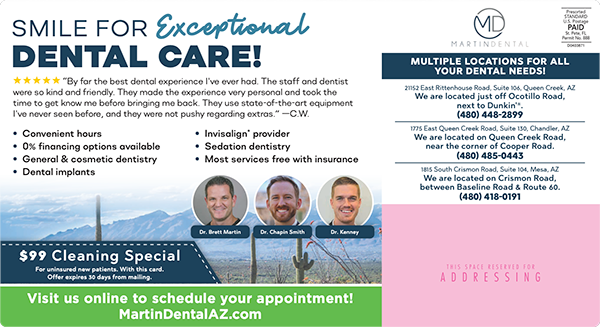
Schedule an appointment at Martin Dental. Call Queen Creek at 480-542-4433, Chandler at 480-508-0237, or Mesa at 480-439-3397. You can additionally contact us online.
Queen Creek: 21152 E Rittenhouse Rd #106, Queen Creek, AZ 85142.
Hours: Monday–Thursday, 8AM–5PM; Friday, 8AM–12PM (By Appointment Only).
Chandler: 1775 E Queen Creek Rd. #129-130, Chandler, AZ 85286.
Hours: Monday–Thursday, 8AM–5PM; Friday, 8AM–2PM (By Appointment Only).
Mesa: 1815 South Crismon Road Suite 104, Mesa, AZ 85209.
Hours: Monday–Thursday, 8AM–5PM; Friday, By Appointment Only.
Get Started
Fill out form below